The workshop has phoned you with the number, and it’s bigger than you hoped. Now you’re weighing three options: rebuild the gearbox you have, buy a factory-new replacement, or fit a used unit from a scrapyard or importer.
Nobody enjoys this decision, and the workshops that dodge the number are the ones that lose customers. So here’s the honest version of how the three options compare, what drives the price, and how to choose without regretting it in eighteen months.
One thing to settle first. A rebuild is not a repair. A repair fixes one fault inside a gearbox that is otherwise healthy. A rebuild strips the box to a bare casing and replaces every wear part. Those are different jobs at different prices, and workshops sometimes use the words interchangeably. Ask which one you’re being quoted for.
What a gearbox rebuild actually involves
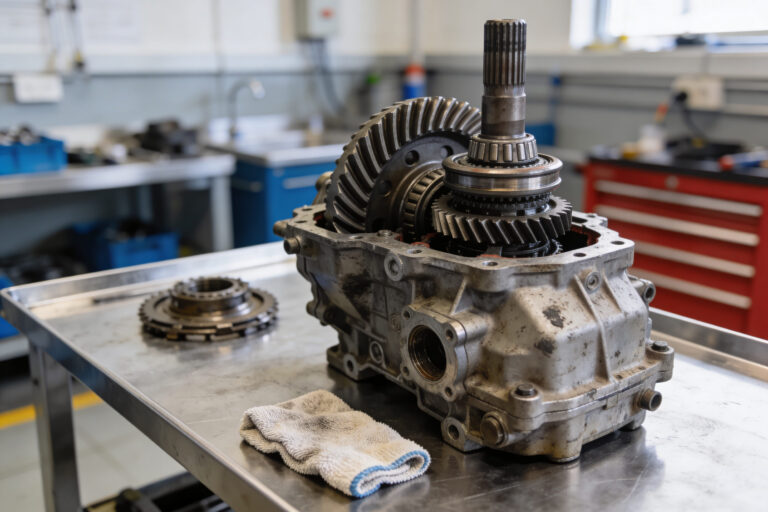
A rebuild is a full strip and reassemble. Once the box is out of the car, it gets washed and disassembled down to the housing. Every internal part is measured against the manufacturer’s tolerances.
Then the parts that wear get replaced as a matter of course, whether or not they’ve failed yet. That means the full bearing set, every seal and O-ring, the gasket set, the synchroniser rings on a manual, and the clutch packs and bands on an automatic. Shafts, gears and the casing are reused if they measure within spec. Anything scored, cracked or worn past tolerance gets replaced individually.
After assembly, the unit is bench tested or road tested, and the adaption values are reset so the control module relearns its shift pressures from scratch.
What you’re buying with a rebuild is knowledge. You know what’s inside it, you know which parts are new, and you know it was assembled by someone who can be held to it. That’s worth more than it sounds, because the alternative is a box with an unknown history.
What “replacement” can actually mean
Replacement is not one thing either. There are three distinct products on the market, and the price gap between them is enormous.
Factory new. A brand-new unit from the manufacturer. It’s the only option with zero unknowns. It’s also the most expensive by a wide margin, often enough to make the repair uneconomical on a car worth less than the gearbox. On some older models it’s simply no longer available.
Remanufactured. A factory or authorised rebuilder takes a used core and rebuilds it to original specification, then tests it. In practice this is a rebuild, done by someone else, with a warranty that may or may not be enforceable from South Africa. Quality varies enormously. Ask who did the work and where the warranty is honoured.
Used or imported. A unit pulled from a written-off vehicle. Cheapest of the three, most common in the market, and the one with the most risk. You’re buying someone else’s mileage. The box may have done 40,000 km, or 400,000. Nobody can tell you which. It may also be a known weak point in that model, which is exactly why the donor car ended up in a yard.
The decision table
Here’s how the three options compare on the factors that actually affect your wallet.
| Factor | Rebuild your box | Factory new | Used or imported |
|---|---|---|---|
| Upfront cost | Middle | Highest, often by a lot | Lowest |
| Fitting labour | One removal and refit | One removal and refit | One removal and refit, plus a second if it fails |
| Known condition | Fully known, parts documented | Fully known, brand new | Unknown mileage and history |
| Matching to your vehicle | The original unit, original calibration | Correct part number for your VIN | May need coding, may not match your ECU |
| Warranty | Workshop warranty on the rebuild | Manufacturer warranty | Often none, or a short parts-only guarantee |
| Availability | Parts sourced, usually a week or two | Can be weeks to months on older models | Immediate, if the exact unit is in stock |
| Best suited to | Older and high-mileage vehicles, specialist or commercial boxes | Late-model vehicles, still under warranty or near new | Older common models where you accept the risk, or an emergency stopgap |
What each option typically costs in South Africa
Exact numbers differ by vehicle, gearbox type and parts availability. These are the typical ranges we see for passenger cars.
A manual gearbox rebuild commonly lands somewhere between R8,000 and R25,000. Manuals are simpler, with fewer parts and no hydraulics to recondition, so the rebuild cost is lower.
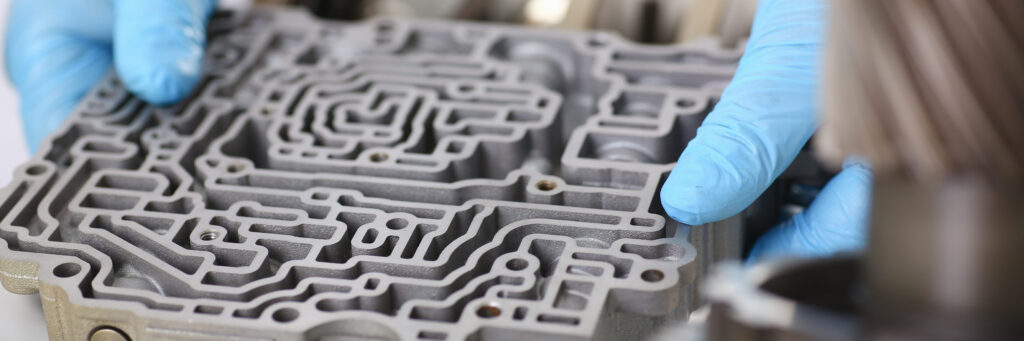
An automatic gearbox rebuild typically runs from R18,000 to R45,000. The range is wide because an automatic contains valve body work, a torque converter to recondition, and far more friction parts. A dual-clutch box with mechatronic work sits at the top of that range or above it.
A factory new automatic commonly starts around R60,000 and goes well past R150,000 on premium and late-model vehicles. On anything older than about eight years, availability becomes the bigger problem than price.
A used unit might be R6,000 to R25,000 for the part. Then you add removal and refitting labour, which is the same labour you’d pay for a rebuild. If the used box fails, you pay it again.
Commercial vehicle gearboxes scale up from these figures, and the numbers swing widely between a light bakkie box and a heavy truck unit. Those get quoted per vehicle after inspection, because the parts and the downtime stakes are both higher.
None of these numbers mean anything until your gearbox has been inspected. A price quoted before a strip-down is an estimate, not a quote. Treat it that way, and get it in writing. Our gearbox rebuild and reconditioning service includes the strip-down inspection and a written quote before any work starts.
When a rebuild is the right call
A rebuild usually wins in four situations.
Your car is older or high-mileage, and the gearbox is the original matching unit. Keeping it means keeping the calibration the car was built around.
The gearbox is a specialist or commercial unit where used stock is thin and new stock is either unavailable or priced beyond the vehicle’s value. This is common on commercial transmissions and on less common import models.
You plan to keep the vehicle for several more years. A rebuild amortises well over a long ownership; a used box that fails after eight months does not.
The fault is internal and progressive. If the pan is full of clutch material and the box is slipping, the wear is spread through the unit. Replacing one part won’t fix the rest, and the second failure isn’t far off.
When replacement makes more sense
Factory new is the sensible choice on a late-model vehicle, especially one still under manufacturer warranty, where fitting anything other than a new unit may void that warranty. It’s also the cleaner call if the vehicle’s value comfortably supports it and you want the longest possible run without thinking about the gearbox again.
A used unit can be a reasonable stopgap on a cheap runaround where you need the car mobile for a few more months and the vehicle’s value doesn’t justify a rebuild. Be clear with yourself about that. It’s a stopgap, not a fix.
The two questions to ask before you approve anything
What did you find on the strip-down? A proper workshop can tell you exactly which parts failed, what they measured, and what they’re replacing. If the answer is vague, you’re not talking to a specialist.
What is the warranty, in writing? Rebuilds carry workshop warranties. Used units carry whatever the yard offers, which is often nothing useful. Get the term and the covered parts on paper before you commit.
Those two answers tell you more than the price does. A cheap rebuild from someone who can’t describe what they replaced will cost you more than an honest one.
Frequently asked questions
How long does a gearbox rebuild take?
A manual rebuild is often completed inside a week. An automatic typically runs one to two weeks, because the torque converter is sent away for reconditioning and the unit is bench tested before it goes back into the car. Sourcing internal parts for imported vehicles is usually the longest step.
Is a rebuilt gearbox as good as a new one?
In use, a properly rebuilt gearbox performs like the original. Every wear part is new, tolerances are measured, and it’s tested before fitting. The difference is that the housing and the hard parts are used, which is fine when they measure within specification. On a well-understood gearbox with good parts supply, a rebuild is a sound long-term repair.
Can I rebuild a gearbox myself?
On a simple manual box, some owners do. On an automatic, the hydraulic control and the tolerances make home rebuilding a poor gamble, and one mistake sends debris through the whole unit. It also usually needs a bench test and adaption reset afterwards, which needs dealer-level tooling.
Won’t a used gearbox from a scrapyard be cheaper and quicker?
Cheaper upfront, yes. Quicker, sometimes. But you’re buying unknown mileage from a vehicle that was written off, and if it fails you pay the removal and refitting labour a second time. On a car you intend to keep, that gamble usually costs more than it saves.
Written by the team at HM Transmissions, a specialist transmission and drivetrain workshop at 33 Patrys Crescent, Okavango Park, Brackenfell, Cape Town. We rebuild and recondition automatic and manual gearboxes, repair commercial vehicle transmissions, and recon differentials, propshafts and mechatronic units.