A differential rarely fails without warning. It complains for weeks, sometimes months, before anything breaks. The trouble is that the complaints sound like something else. A whine at 80 km/h gets blamed on tyres. A clunk on pull-away gets blamed on the suspension. A vibration at highway speed gets blamed on wheel balancing.
By the time the noise is loud enough to ignore, the damage inside the diff has usually moved past a bearing and into the crown wheel and pinion. That’s the difference between a repair and a rebuild.
We diagnose and recondition differentials, propshafts and CV joints at our workshop in Okavango Park, Brackenfell. Here’s what to listen for, and how to tell a drivetrain fault from the things drivers usually blame first.
The differential, in one paragraph
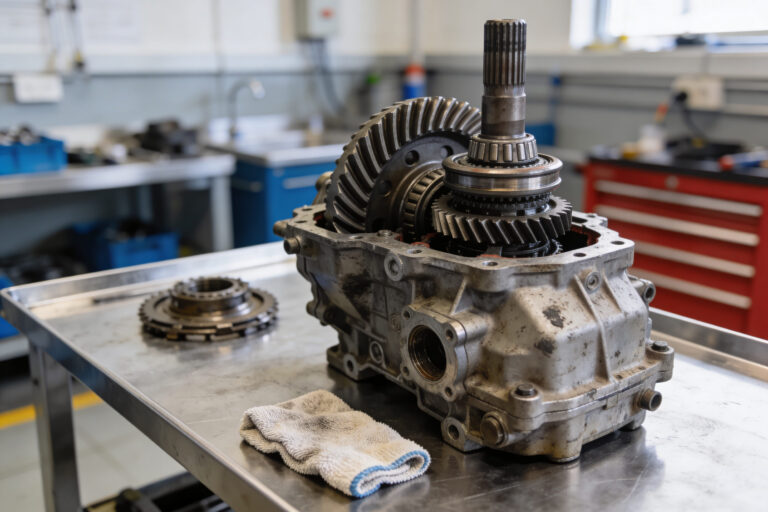
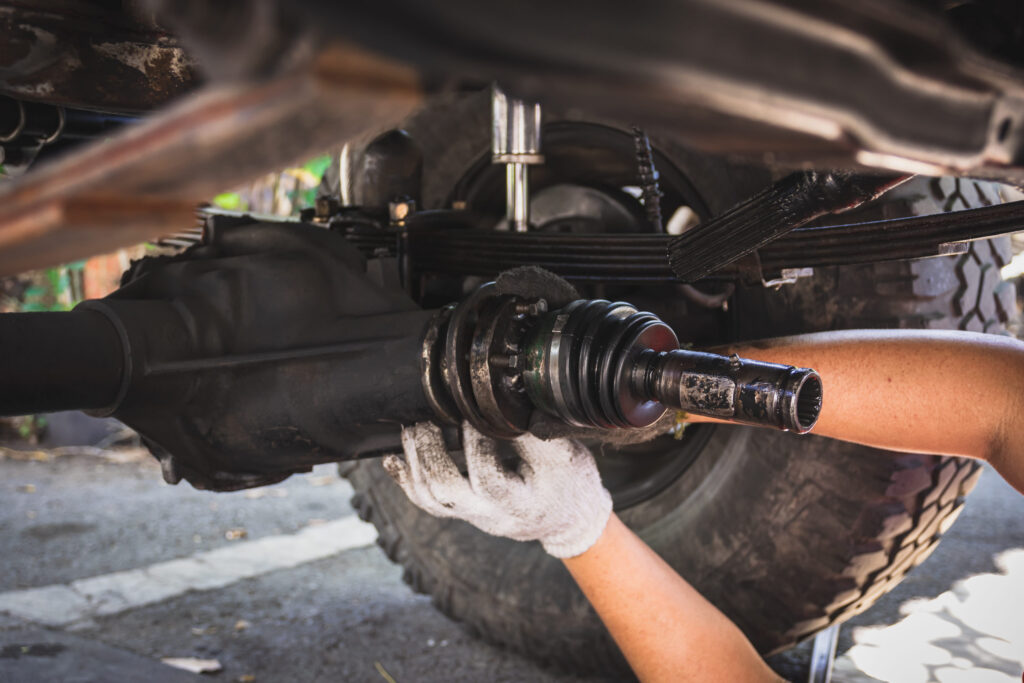
The differential sits between the two driven wheels and lets them turn at different speeds while the car goes around a corner. Inside it there’s a crown wheel and pinion, a set of spider gears, bearings and seals, all running in oil. The propshaft carries drive from the gearbox to the diff, with universal joints at each end and often a centre bearing along the way. On front-wheel-drive and independent-suspension cars, CV joints do the same job as universal joints while also allowing the wheels to steer and move up and down.
Every one of those parts wears. How you catch the wear determines what it costs.
Differential symptoms you shouldn’t ignore
A whine or howl that follows road speed. This is the classic differential complaint. The noise appears at a certain speed, stays at the same pitch in every gear, and changes when you lift off or accelerate. That last detail is the giveaway. Diff whine usually changes under load, getting louder when you accelerate and quieter when you coast. Tyre noise doesn’t care whether you’re on the power.
A clunk when you take up drive. Select reverse after being parked, or let the clutch out in first, and you hear a single solid thud from underneath. That’s excessive backlash, usually from worn gears or a worn pinion bearing. It’s also a common propshaft universal joint symptom, so the two get checked together.
A rumble that gets worse with speed. A failing diff bearing produces a deep rumble that rises steadily with road speed and doesn’t change when you change gear. Left alone, a collapsing bearing destroys the crown wheel and pinion as the pinion moves out of mesh.
Oil weeping onto the diff housing or the driveway. A failing pinion or output shaft seal lets oil out and water and grit in. The oil level drops quietly, and the top of the diff runs dry before anything sounds unusual.
One wheel spinning while the other does nothing. On a vehicle with an open diff that’s normal. On a limited-slip or locking diff, it means the friction plates or the locking mechanism have worn out.
Shuddering or binding when turning at low speed. Typically a limited-slip diff with the wrong oil or worn clutch plates, and often worse when the diff is cold. Going around a tight corner in a parking lot feels like the back end is dragging.
Propshaft and CV joint symptoms
Vibration through the seat, floor or gear lever at a specific speed. Propshaft vibration usually appears in a narrow band, often around 80 to 100 km/h, and then seems to smooth out as you go faster. It’s often worse under acceleration than coasting. This is the one drivers most often mistake for wheel balancing, and the two genuinely sound alike. A balancing problem usually shows in the steering wheel, a propshaft problem usually shows through the floor and the seat.
A rhythmic clunk or knock on pull-away. A worn universal joint develops play before it fails. You hear a knock as the slack is taken up, then it goes quiet once the drivetrain is loaded.
Clicking while turning. The signature of a worn outer CV joint. It clicks or taps on full lock, and it’s loudest when you turn while accelerating. Every front-wheel-drive car with significant mileage will do this eventually. Catching it at the click stage means replacing a joint. Ignoring it means the joint can let go, and a separated CV joint leaves you stranded.
A torn CV boot and grease thrown around the inner wheel arch. The boot is what keeps the grease in and the grit out. Once it splits, the joint wears quickly and the failure arrives early. Boots are cheap. Joints are not.
A shudder when accelerating from low speed. On a vehicle with a two-piece propshaft, a worn centre bearing or a collapsed support rubber produces a shudder you feel through the whole car right as load comes on.
The symptoms that get blamed for something else
This is where the cost creeps up. Three faults get misdiagnosed constantly.
Tyres. Worn or unevenly worn tyres produce a howl that sounds like diff whine. The difference is that tyre noise starts lower in the speed range, doesn’t change with load, and may change when you swap wheels front to back. If the noise moves when you rotate the tyres, the tyres are the noise.
Wheel bearings. A failing wheel bearing rumbles like a diff bearing. The test is to load each side in turn, because a wheel bearing gets louder or quieter when you steer or change direction and take weight off it. A diff bearing doesn’t care which way you steer.
Gearbox mountings and engine mountings. A collapsed mounting produces a clunk on pull-away and a vibration through the car that people attribute to the drivetrain. It’s cheaper to find, and worth ruling out before any gearbox gets stripped.
Getting the diagnosis right first is what saves the money. We road test with the fault reproduced, put the vehicle on a lift and check for play and backlash at every joint, look at the oil for metal, and only then quote. That inspection forms part of our differential, propshaft and drivetrain service.
What differential and propshaft repairs typically cost
Ranges for passenger cars and light commercial vehicles in Cape Town. The number that matters is always the one quoted after the fault has been found and inspected.
| Symptom | Likely cause | Typical repair | Typical cost range |
|---|---|---|---|
| Split CV boot, grease thrown around the wheel | Torn boot, early joint wear | Boot kit and grease, joint inspected | R900 – R2,500 per joint |
| Clicking on full lock when turning | Worn outer CV joint | CV joint replacement | R2,000 – R5,000 per side |
| Vibration at 80 – 100 km/h under load | Worn universal joint or propshaft balance | UJ replacement, propshaft balancing | R2,500 – R8,000 |
| Clunk when taking up drive | Worn UJ, diff backlash or mounting | Diagnosis first, then UJ or diff work | R1,500 – R8,000 |
| Whine that follows road speed and load | Crown wheel, pinion or diff bearing wear | Differential rebuild with bearing and gear set | R6,000 – R20,000 |
| Oil leaking at the diff, limited-slip binding | Failed seals, worn limited-slip plates | Seal replacement or limited-slip rebuild | R2,500 – R12,000 |
A differential rebuild is one of the few jobs where the cost varies most with how long you waited. A bearing replacement inside a healthy diff is a much smaller job than rebuilding a diff whose crown wheel and pinion have been chewed up by a collapsed bearing.
Why waiting costs more
A differential runs on a thin film of oil between gear teeth under heavy load. When a bearing starts to fail, the pinion moves slightly out of its correct mesh with the crown wheel. The contact pattern changes. Instead of the load spreading across the tooth face, it concentrates on an edge.
From there it escalates quickly. The oil picks up metal particles from the failing bearing, and those particles lap away at the gear faces and the remaining bearings. A diff that came in with one noisy bearing can leave needing a full gear set, and gear sets for imported vehicles aren’t always quick to source.
The same logic applies to a propshaft. Ignore a worn universal joint and the vibration starts working on the output shaft seal at the gearbox end and the pinion seal at the diff end. Now you’re replacing seals as well as the joint, and if the propshaft lets go at speed, the damage underneath the vehicle is unpredictable.
On a CV joint, the sequence is faster still. A split boot lets grit into the joint, the joint wears, and once the cage fails the joint can separate. If it separates while you’re driving, you lose drive and you stop where you are.
Cape Town conditions that speed this up
Our roads do drivetrain components no favours. The cambered, patched and potholed surfaces on the older suburban routes and the mountain passes put sharp shock loads through propshafts and CV joints every day. Every pothole is a jolt through a universal joint with play in it.
Corrosion plays its part too. Coastal air around the Atlantic Seaboard, Blouberg and the False Bay towns accelerates the breakdown of rubber boots and the rubber propshaft coupling. A boot that would last eight years inland can split in five here.
And Cape Town is a city of hills. Constant climbing and descending loads the drivetrain in both directions, which is exactly the load pattern that exposes a worn diff bearing or a failing limited-slip unit.
Frequently asked questions
How do I know if it’s my differential or just my tyres?
Tyre noise starts at lower speeds, doesn’t change when you lift off the accelerator, and changes when you rotate the wheels front to back. Differential whine appears at a specific road speed, changes pitch and volume with load, and stays with the vehicle no matter where the wheels are. If rotating the tyres moves the noise, it was the tyres.
Can I drive with a whining differential?
For a short distance, carefully, to get it to a workshop. Continuing to drive on it is what turns a bearing replacement into a full rebuild with a new crown wheel and pinion. The whine itself isn’t the danger. The metal circulating through the oil is.
How long does a differential rebuild take?
Typically two to five days for a passenger car or light commercial vehicle. The diff comes out, gets stripped and inspected, and the crown wheel and pinion are set up with the correct contact pattern and backlash, which is a measuring job rather than a swop-over. Sourcing a gear set for an imported vehicle is usually the longest part of the wait.
Is a clicking noise on turns always a CV joint?
Almost always on a front-wheel-drive car. It can also come from a worn wheel bearing, a loose brake component or, on a rear-wheel-drive vehicle, from a limited-slip differential. The pattern of the noise tells us which, and a lift inspection confirms it in minutes.
Written by the team at HM Transmissions, a specialist transmission and drivetrain workshop at 33 Patrys Crescent, Okavango Park, Brackenfell, Cape Town. We diagnose and recondition differentials, propshafts and CV joints, and rebuild automatic and manual transmissions for private owners and commercial fleets.