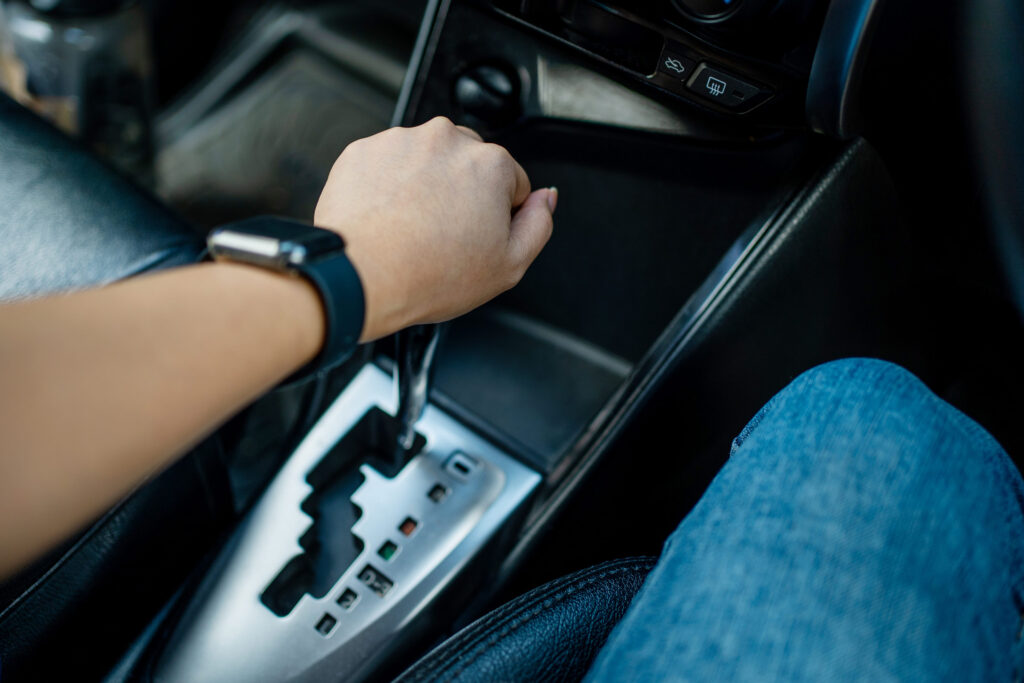
You put your foot down and the revs climb, but the car doesn’t pull. Or it thumps into gear from a standstill hard enough to make you wince. One driver described it to us as “my car stopped accelerating when I went past 2000 RPM” — the revs keep climbing, the speed doesn’t follow, and the gearbox feels like it’s thinking about it. That is an automatic transmission slipping.
Slipping and jerking are symptoms, not a verdict. Some causes cost a few hundred rand to sort out. Others mean the gearbox has to come out of the car. The only honest way to know which one you’re dealing with is a diagnosis, and that diagnosis costs far less than guessing wrong and driving on a damaged box for another month.
We rebuild and recondition automatic transmissions at our workshop in Okavango Park, Brackenfell, so we see this every week. Here’s what’s actually happening inside the gearbox, and what you’re realistically looking at paying.
What slipping, flaring and jerking actually feel like
The words get used loosely. They describe different faults, and they point at different parts inside the box.
Slipping is when the engine revs rise but the road speed doesn’t keep up. You notice it under load — pulling away uphill, joining the N1, or towing. The engine sounds like it’s working, but the car isn’t moving any faster.
Flaring is the same thing at a gear change. Instead of the revs dropping when it shifts up, they spike briefly before the next gear grabs. It’s most obvious between second and third.
Jerking is a mechanical thump or shudder. You feel it when it engages drive from a standstill, or when it shifts down under braking. Sometimes it feels like the whole car lurches. On a dual-clutch box, low-speed judder is the classic complaint.
Delayed engagement is different again. You select drive, and nothing happens for two or three seconds. Same when you select reverse. That delay usually points at fluid pressure, not at worn internals.
Why automatic gearboxes slip and jerk
An automatic gearbox works on hydraulic pressure. Fluid pressure pushes on clutch packs and bands to hold each gear ratio. When pressure drops, or when the friction surfaces wear, the gear can’t hold and it slips. That’s the whole mechanism in one sentence.
In practice, the pressure drops for one of a handful of reasons.
Low or burnt fluid. The most common cause by a mile. Fluid leaks out slowly through a worn seal or a cracked pan gasket, and the level drops until pressure falls with it. Fluid that’s gone dark and smells burnt has been overheated, and overheating glazes the clutch plates. Topping it up treats the symptom. You still need to find the leak and work out what cooked the fluid.
Wrong fluid. Modern automatics are fussy. Each box is designed around a specific fluid spec. If someone put the wrong spec in at a service, shift quality goes off gradually and the clutch packs wear faster. We see this on imported vehicles where the correct fluid was hard to find locally.
A clogged filter or blocked valve body passage. There’s a filter in the sump, and a maze of tiny channels in the valve body that route fluid. Varnish and debris block those channels. Pressure drops in the circuit that runs one particular gear, and that gear starts slipping while the rest feel fine.
A sticking or failed solenoid. Solenoids are electric valves that tell the gearbox when to shift. When one sticks, you get a harsh shift, a flare, or a gear that refuses to engage. A solenoid fault often triggers limp mode, and the car locks itself into one gear to protect the internals.
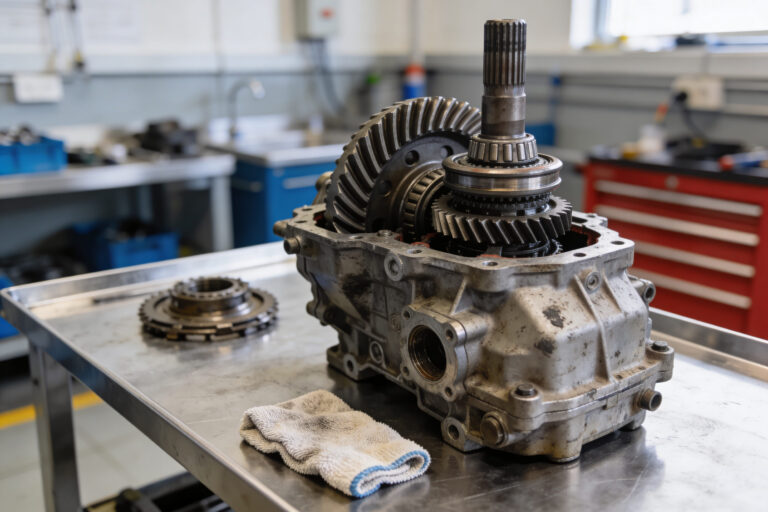
Worn clutch packs and seals. Internally, an automatic is a stack of clutch packs, steel plates, seals and bearings. Every pack has a friction surface that wears down over its life. Once the material is gone, no fluid change will bring it back. This is the point where the box comes out and gets rebuilt.
Torque converter failure. The converter is the fluid coupling between engine and gearbox. When its internal lock-up clutch fails, you get a shudder at low speed and a slip that gets worse as the box heats up. A failing converter also sheds debris into the fluid, which then damages everything downstream.
Mechatronic unit faults. On modern dual-clutch and certain automatic boxes, the mechatronic unit combines the hydraulic control body with the electronic control module. It’s the brain and the muscles in one housing. Seal failure inside the unit causes pressure loss, and you get jerking, hesitation and juddering at low speed. We repair and refurbish these units rather than automatically replacing them.
What a proper diagnosis involves
You can’t diagnose an automatic gearbox by test driving it around the block. Anyone who quotes you a price over the phone without scanning the car is guessing, and you’ll wear the cost of that guess.
A proper diagnosis starts with a fault-code scan of the transmission control module. Then we read live data — pressures, temperatures, solenoid duty cycles, and the adaption values the box has learned over time. Those adaption values are revealing. A box that has been slipping for months will have shifted its own settings to compensate, and you can see it in the numbers.
Then we check the fluid condition and level on the specific procedure for that gearbox, because many modern boxes have no dipstick and have to be checked at a set temperature with the engine running. After that, a road test with the scan tool connected while we drive, so the faults show up in real data rather than as a description.
Often we also drop the sump and look at the pan magnet. Fine metallic paste is normal wear. Chunks, bright metal flakes or clutch material in the pan tell you the inside of the box is already damaged.
The full scope of what we test and repair sits on our transmission and drivetrain services page.
What automatic transmission repair typically costs in South Africa
These are typical workshop ranges for passenger cars in Cape Town. On an automatic gearbox, the final number depends on the vehicle, the parts availability, and how much damage was done by continuing to drive on a slipping box.
| Fault | What you notice | Typical repair | Typical cost |
|---|---|---|---|
| Low or burnt fluid | Delayed engagement, hesitation when cold | Fluid and filter service, plus tracing the leak that caused it | R1,500 – R4,500 |
| Sticking solenoid | One gear missing, harsh shifts, limp mode | Solenoid replacement and a fluid service | R4,000 – R12,000 |
| Valve body fault | Flaring between gears, harsh downshifts | Valve body strip and recondition | R6,000 – R18,000 |
| Torque converter failure | Shudder at low speed, slip when hot | Converter recondition or replacement | R8,000 – R25,000 |
| Mechatronic unit fault | Low-speed judder, hesitation, fault codes | Mechatronic repair or refurbishment | R12,000 – R35,000 |
| Worn clutch packs and seals | Slip under load, burnt smell, metal in the pan | Full gearbox rebuild with new friction and seal kit | R18,000 – R45,000 |
A rebuild sounds expensive until you compare it to a replacement. A new factory automatic box for a modern vehicle commonly runs into six figures, and on older models it isn’t available at all. A used unit from a scrapyard is cheaper upfront, but you’re buying someone else’s unknown history with no warranty worth the paper it’s printed on. A proper rebuild gives you known internals, new wear parts, and a working warranty.
Can you drive it like this for a while?
No. Slipping gets worse, and it gets worse faster than most people expect.
Every slip event generates heat. Heat glazes the friction plates and cooks the fluid. Burnt fluid loses its lubricating properties, and then the bearings and the valve body start wearing too. What would have been a solenoid and a fluid service at R6,000 becomes a full rebuild at triple that, because the debris from the first fault has circulated through the whole box.
If the box has gone into limp mode, that’s a protection strategy. It has locked itself into a gear because it detected something it can’t control. Driving on it in limp mode doesn’t achieve anything except adding heat and wear.
The one thing worth doing immediately is checking the fluid level, if your car has a dipstick. If it’s low, top it up with the correct spec fluid, then drive straight to a workshop. Don’t add anything from a bottle that promises to fix a slipping gearbox. Those products thicken the fluid and buy you a fortnight at the cost of a contaminated valve body.
Why Cape Town driving is hard on automatic gearboxes
Cape Town is a stop-start city built on hills. Voortrekker Road, the N1 through the Tygerberg, Sir Lowry’s Pass, and the daily crawl out of the southern suburbs all put an automatic box through thousands of shift cycles a day. Each shift wears the friction material a little.
Summer heat makes it worse. Transmission fluid has a working temperature range, and stop-start traffic on a 35°C day pushes fluid past it. Once fluid overheats, its life shortens dramatically, and a box that might have gone 250,000 km starts complaining at 150,000.
Towing is the other big one. A caravan to Theewaterskloof or a trailer full of building material turns a comfortable drive into continuous high-load work for the gearbox. That’s the load condition where a worn box slips first, and it’s also where the damage happens fastest.
If you tow regularly, a transmission cooler and a more frequent fluid service interval are the two cheapest things you can do for the box’s lifespan.
Frequently asked questions
Can an automatic transmission be repaired without replacing the whole gearbox?
Yes, and that’s the usual outcome. Most faults are repaired in the box, in the car, or in the valve body without a full replacement. A complete rebuild is only needed when the internal clutch packs and bearings are worn out. That decision comes after the box is stripped and inspected, never before.
Is it cheaper to buy a second-hand gearbox than to rebuild mine?
Sometimes, on paper. A used box is cheaper upfront, but its mileage and history are unknown to you, it may have the same design fault yours just failed with, and the labour to fit it is the same. If it fails, you pay that labour twice. On a vehicle we know well, a rebuild usually works out cheaper over the life of the car.
How long does an automatic transmission repair take?
A fluid and solenoid job is often done in a day. A valve body recondition takes a few days. A full rebuild typically runs one to two weeks, because the box is stripped, the converter is sent for reconditioning, and the unit is bench tested before it goes back in. Part availability for imported vehicles is the main variable.
Why does my gearbox only slip when it’s cold, or only when it’s hot?
Fluid viscosity changes with temperature, so pressure changes with it. Cold shifting complaints usually point at fluid condition or a sticking solenoid. Faults that appear only once the box is hot usually point at internal wear or a converter problem, because hot thin fluid escapes through worn clearances that it can’t get past when cold. Both are diagnosable from live data.
Written by the team at HM Transmissions, a specialist transmission and drivetrain workshop at 33 Patrys Crescent, Okavango Park, Brackenfell, Cape Town. We rebuild automatic and manual transmissions, repair commercial vehicle gearboxes, and recondition differentials, propshafts, CV joints and mechatronic units.
On this page
- What slipping, flaring and jerking actually feel like
- Why automatic gearboxes slip and jerk
- What a proper diagnosis involves
- What automatic transmission repair typically costs in South Africa
- Can you drive it like this for a while?
- Why Cape Town driving is hard on automatic gearboxes
- Frequently asked questions